From Dr Norman Page
Houston Blog http://climatesense-norpag.blogspot.com.
Dear Professor Belcher
There has been no net warming since 1997 with CO2 up over 8%, The warming trend peaked in about 2003 and the earth has been cooling slightly for the last 10 years . This cooling will last for at least 20 years and perhaps for hundreds of years beyond that.. The Met office and IPCC climate models and all the impact studies depending on them are totally useless because they are incorrectly structured. The models are founded on two irrationally absurd assumptions.First that CO2 is the main driver - when CO2 follows temperature .The cause does not follow the effect. Second piling stupidity on irrationality the models add the water vapour as a feed back to the CO2 in order to get a climate sensitivity of about 3 degrees. Water vapour follows temperature independently of CO2 and is the main GHG.
Furthermore apart from the specific problems in the Met- IPCC models ,models are inherently useless for predicting temperatures because of the difficulty of setting the initial parameters with sufficient precision.Why you think you can iterate more than a couple of weeks ahead is beyond my comprehension.After all you gave up on seasonal forecasts.
For a discussion of the right way to approach forecasting see
http://climatesense-norpag.blogspot.com/2013/05/climate-forecasting-basics-for-britains.html
and several other pertinent posts also on http://climatesense-norpag.blogspot.com.
Here is a summary of the conclusions.
"It is not a great stretch of the imagination to propose that the 20th century warming peaked in about 2003 and that that peak was a peak in both the 60 year and 1000 year cycles.On that basis the conclusions of the post referred to above were as follows.
1 Significant temperature drop at about 2016-17
2 Possible unusual cold snap 2021-22
3 Built in cooling trend until at least 2024
4 Temperature Hadsst3 moving average anomaly 2035 - 0.15
5Temperature Hadsst3 moving average anomaly 2100 - 0.5
6 General Conclusion - by 2100 all the 20th century temperature rise will have been reversed,
7 By 2650 earth could possibly be back to the depths of the little ice age.
8 The effect of increasing CO2 emissions will be minor but beneficial - they may slightly ameliorate the forecast cooling and help maintain crop yields .
9 Warning !! There are some signs in the Livingston and Penn Solar data that a sudden drop to the Maunder
Minimum Little Ice Age temperatures could be imminent - with a much more rapid and economically disruptive cooling than that forecast above which may turn out to be a best case scenario.
For a dicussion of the effects of cooling on future weather patterns see the 30 year Climate Forecast 2 Year update at
http://climatesense-norpag.blogspot.com/2012/07/30-year-climate-forecast-2-year-update.html
How confident should one be in these above predictions? The pattern method doesn't lend itself easily to statistical measures. However statistical calculations only provide an apparent rigour for the uninitiated and in relation to the climate models are entirely misleading because they make no allowance for the structural uncertainties in the model set up.This is where scientific judgement comes in - some people are better at pattern recognition than others.A past record of successful forecasting is a useful but not infallible measure. In this case I am reasonably sure - say 65/35 for about 20 years ahead. Beyond that, inevitably ,certainty drops."
It is way past time for someone in the British scientific establishment to forthrightly say to the government that the whole CO2 scare is based on a mass delusion and try to stop Britain's lunatic efforts to control climate by installing windmills.
As an expat Brit I watch with fascinated horror as y'all head lemming like over a cliff. I would be very happy to consult for the Met on this matter- you certainly need to hear a forthright skeptic presentation to reconnect with reality.
Best Regards Norman Page.
Saturday, June 15, 2013
Sunday, June 2, 2013
Oklahoma Tornadoes and Sandy type Hurricanes reflect Global Cooling not Warming.
Most climate warming alarmists have recently realised that it is now counterproductive to attribute every and all extreme weather events ( even cold snowy winters) to global warming and try to project a judicious objectivity by applying the cliche "weather isn't climate" to both sides of the climate wars. In fact weather is an almost instantaneous slice through the climate space- time phase space and certain patterns will occur more frequently on a cooling rather than a warming world.Here I will deal in the main with the USA because each region will interact with the warming or cooling changes in the great ocean and atmospheric current systems according to its particular topography and geography.
The basic principles are very simple. On a cooler earth the temperature gradient from the tropics to the arctic circle is steeper.This creates instability and the jet stream swings further North and South as opposed to its more West - East path during warmer periods.According to the season ,blocking highs may develop with colder dryer air penetrating further South and warm moist air reaching further North. There can be enormous temperature and humidity contrasts in the narrow boundary between these masses as warm air is sucked in from the Gulf . Conditions alomg such a boundary are ideal for developing the wind shear necessary for the tornado swarm development seen recently in Oklahoma.The blocking highs also push hurricanes to the east so that hurricanes like Sandy are more likely to occur.Note that Sandy was not a powerful Hurricane in fact it came ashore as a tropical storm. The big storm surge was the result of its long path over open water while a real cooling signal was seen in the development of blizzard conditions in the NW quadrant.This classic weather pattern is shown for today 6/02/13 in Figs 1 and 2 and occurs more often during a cooling phase of the PDO and is often triggered by an E Pacific La Nina cooling. as seen in the 6/01/13 SST anomaly map Fig 3
(TOH to The Weather Channel) It is worth noting that the pattern seen in Fig 1 is also ideal for steering any Atlantic Hurricane which develops this season in a Sandy type direction.
Fig1
Fig2
Fig3
By contrast on a warmer world tropical SSTs are higher EL Ninos more common and more powerful category 4 and 5 hurricanes eg Katrina and Gilbert can develop .Their path is more E- W so that they more frequently hit the Gulf Coast or even Central America.
More generally- a cooling earth is a dryer earth because the winds pick up less water vapour from the cooler oceans.In the USA the cool waters off the West Coast (fig3) will lead to more generalised droughts in the Center , West and SW and when combined with more frequent late and early frosts and snows food crop production will be threatened .What rains do come will paradoxically come from storms leading to flash flooding further restricting food production.In California itself the south will be dryer with more forest fires while in the North more of the rains will come as snow so that increasing snow pack will ameliorate the overall dryer conditions.
Most of the ideas expressed above were included in the post ""30 Years Climate Forecast" in June 2010 on my blog at http://climatesense-norpag.blogspot.com. and revisited in June 2012 in the post "30 Year Climate Forecast -2 year update."
There has been no net warming since 1997 with CO2 up over 8%. The SSTs show a cooling trend since 2003.
The problem with the IPCC- MetOffice Climate models is that, apart from the egregious structural errors in the specific models, (assuming that CO2 is the main driver when it clearly follows temperature and adding water vapour as a feedback onto CO2 to increase the sensitivity) climate science is so complex that the modelling approach is inherently incapable of providing useful forecasts for several reasons -for starters the difficulty of specifying the initial conditions with sufficient precision. All the IPCC model projections and the impact studies and government policies which depend on them are a total waste of time and money. The only useful approach is to perform power spectrum and wavelet analysis on the temperature and possible climate driver time series to find patterns of repeating periodicities and project them forward. When this is done it is apparent that the earth entered a cooling phase in 2003-4 which will likely last for 20 more years and perhaps for several hundred years beyond that. For the data and references supporting this conclusion check the post “Climate Forecasting Basics for Britains Seven Alarmist Scientists” and several earlier posts on Climate Forecasting and Global Cooling especially "Global Cooling - Climate and Weather Forecasting" from 11/18/13.
Here is a summary of the latest forecast based not on the particular events referred to above but on the data and references linked in the series of posts on the climatesense-norpag site.
"It is not a great stretch of the imagination to propose that the 20th century warming peaked in about 2003 and that that peak was a peak in both the 60 year and 1000 year cycles.On that basis the conclusions of the posts referred to above were as follows.
1 Significant temperature drop at about 2016-17
2 Possible unusual cold snap 2021-22.
3 Built in cooling trend until at least 2024
4 Temperature Hadsst3 moving average anomaly 2035 - 0.15
5Temperature Hadsst3 moving average anomaly 2100 - 0.5
6 General Conclusion - by 2100 all the 20th century temperature rise will have been reversed,
7 By 2650 earth could possibly be back to the depths of the little ice age.
8 The effect of increasing CO2 emissions will be minor but beneficial - they may slightly ameliorate the forecast
cooling and help maintain crop yields .
9 Warning !! There are some signs in the Livingston and Penn Solar data that a sudden drop to the Maunder
Minimum Little Ice Age temperatures could be imminent - with a much more rapid and economically disruptive
cooling than that forecast above which may turn out to be a best case scenario"
How confident should one be in these predictions? The pattern method doesn't lend itself easily to statistical measures. However statistical calculations only provide an apparent rigour for the uninitiated and in relation to the IPCC climate models are entirely misleading because they make no allowance for the structural uncertainties in the model set up.This is where scientific judgement comes in - some people are better at pattern recognition than others.A past record of successful forecasting is a useful but not infallible measure. In this case I am reasonably sure - say 65/35 for about 20 years ahead. Beyond that, inevitably ,certainty must drop.
The basic principles are very simple. On a cooler earth the temperature gradient from the tropics to the arctic circle is steeper.This creates instability and the jet stream swings further North and South as opposed to its more West - East path during warmer periods.According to the season ,blocking highs may develop with colder dryer air penetrating further South and warm moist air reaching further North. There can be enormous temperature and humidity contrasts in the narrow boundary between these masses as warm air is sucked in from the Gulf . Conditions alomg such a boundary are ideal for developing the wind shear necessary for the tornado swarm development seen recently in Oklahoma.The blocking highs also push hurricanes to the east so that hurricanes like Sandy are more likely to occur.Note that Sandy was not a powerful Hurricane in fact it came ashore as a tropical storm. The big storm surge was the result of its long path over open water while a real cooling signal was seen in the development of blizzard conditions in the NW quadrant.This classic weather pattern is shown for today 6/02/13 in Figs 1 and 2 and occurs more often during a cooling phase of the PDO and is often triggered by an E Pacific La Nina cooling. as seen in the 6/01/13 SST anomaly map Fig 3
(TOH to The Weather Channel) It is worth noting that the pattern seen in Fig 1 is also ideal for steering any Atlantic Hurricane which develops this season in a Sandy type direction.
Fig1
Fig2
Fig3
By contrast on a warmer world tropical SSTs are higher EL Ninos more common and more powerful category 4 and 5 hurricanes eg Katrina and Gilbert can develop .Their path is more E- W so that they more frequently hit the Gulf Coast or even Central America.
More generally- a cooling earth is a dryer earth because the winds pick up less water vapour from the cooler oceans.In the USA the cool waters off the West Coast (fig3) will lead to more generalised droughts in the Center , West and SW and when combined with more frequent late and early frosts and snows food crop production will be threatened .What rains do come will paradoxically come from storms leading to flash flooding further restricting food production.In California itself the south will be dryer with more forest fires while in the North more of the rains will come as snow so that increasing snow pack will ameliorate the overall dryer conditions.
Most of the ideas expressed above were included in the post ""30 Years Climate Forecast" in June 2010 on my blog at http://climatesense-norpag.blogspot.com. and revisited in June 2012 in the post "30 Year Climate Forecast -2 year update."
There has been no net warming since 1997 with CO2 up over 8%. The SSTs show a cooling trend since 2003.
The problem with the IPCC- MetOffice Climate models is that, apart from the egregious structural errors in the specific models, (assuming that CO2 is the main driver when it clearly follows temperature and adding water vapour as a feedback onto CO2 to increase the sensitivity) climate science is so complex that the modelling approach is inherently incapable of providing useful forecasts for several reasons -for starters the difficulty of specifying the initial conditions with sufficient precision. All the IPCC model projections and the impact studies and government policies which depend on them are a total waste of time and money. The only useful approach is to perform power spectrum and wavelet analysis on the temperature and possible climate driver time series to find patterns of repeating periodicities and project them forward. When this is done it is apparent that the earth entered a cooling phase in 2003-4 which will likely last for 20 more years and perhaps for several hundred years beyond that. For the data and references supporting this conclusion check the post “Climate Forecasting Basics for Britains Seven Alarmist Scientists” and several earlier posts on Climate Forecasting and Global Cooling especially "Global Cooling - Climate and Weather Forecasting" from 11/18/13.
Here is a summary of the latest forecast based not on the particular events referred to above but on the data and references linked in the series of posts on the climatesense-norpag site.
"It is not a great stretch of the imagination to propose that the 20th century warming peaked in about 2003 and that that peak was a peak in both the 60 year and 1000 year cycles.On that basis the conclusions of the posts referred to above were as follows.
1 Significant temperature drop at about 2016-17
2 Possible unusual cold snap 2021-22.
3 Built in cooling trend until at least 2024
4 Temperature Hadsst3 moving average anomaly 2035 - 0.15
5Temperature Hadsst3 moving average anomaly 2100 - 0.5
6 General Conclusion - by 2100 all the 20th century temperature rise will have been reversed,
7 By 2650 earth could possibly be back to the depths of the little ice age.
8 The effect of increasing CO2 emissions will be minor but beneficial - they may slightly ameliorate the forecast
cooling and help maintain crop yields .
9 Warning !! There are some signs in the Livingston and Penn Solar data that a sudden drop to the Maunder
Minimum Little Ice Age temperatures could be imminent - with a much more rapid and economically disruptive
cooling than that forecast above which may turn out to be a best case scenario"
How confident should one be in these predictions? The pattern method doesn't lend itself easily to statistical measures. However statistical calculations only provide an apparent rigour for the uninitiated and in relation to the IPCC climate models are entirely misleading because they make no allowance for the structural uncertainties in the model set up.This is where scientific judgement comes in - some people are better at pattern recognition than others.A past record of successful forecasting is a useful but not infallible measure. In this case I am reasonably sure - say 65/35 for about 20 years ahead. Beyond that, inevitably ,certainty must drop.
Friday, May 31, 2013
Comment on WUWT re Sass Baker Institute Article In Chronicle
Here is a copy of an E-mail I sent to Dr Sass yesterday – so far no reply.
From Dr Norman Page
Houston
Ronald
I saw your piece in the Chronicle this morning.I find myself genuinely puzzled when scientists with your outstanding qualifications continue to support the CAGW meme.
There has been no net warming since 1997 with CO2 up over 8%. The SSTs show a cooling trend since 2003.
The problem with the IPCC- MetOffice Climate models is that, apart from the egregious structural errors in the specific models, (assuming that CO2 is the main driver when it clearly follows temperature and adding water vapour as a feedback onto CO2 to increase the sensitivity) climate science is so complex that the modelling approach is inherently incapable of providing useful forecasts for several reasons -for starters the difficulty of specifying the initial conditions with sufficient precision. All the IPCC model projections and the impact studies and government policies which depend on them are a total waste of time and money. The only useful approach is to perform power spectrum and wavelet analysis on the temperature and possible climate driver time series to find patterns of repeating periodicities and project them forward. When this is done it is apparent that the earth entered a cooling phase in 2003-4 which will likely last for 20 more years and perhaps for several hundred years beyond that. For the data and references supporting this conclusion check the posts “Open letter to Benny Peiser ” and “Climate Forecasting Basics for Britains Seven Alarmist Scientists”
at http://climatesense-norpag.blogspot.com ”
There are a large number of other posts on the same site relative to Climate Forecasting and the impending Global Cooling – I hope you can find the time to check some of them eg “30 year climate Forecast – 2 year update” which looks pretty good.
Here’s my latest forecast summary
“It is not a great stretch of the imagination to propose that the 20th century warming peaked in about 2003 and that that peak was a peak in both the 60 year and 1000 year cycles.On that basis the conclusions of the post referred to above were as follows.
1 Significant temperature drop at about 2016-17
2 Possible unusual cold snap 2021-22
3 Built in cooling trend until at least 2024
4 Temperature Hadsst3 moving average anomaly 2035 – 0.15
5Temperature Hadsst3 moving average anomaly 2100 – 0.5
6 General Conclusion – by 2100 all the 20th century temperature rise will have been reversed,
7 By 2650 earth could possibly be back to the depths of the little ice age.
8 The effect of increasing CO2 emissions will be minor but beneficial – they may slightly ameliorate the forecast
cooling and help maintain crop yields .
9 Warning !! There are some signs in the Livingston and Penn Solar data that a sudden drop to the Maunder
Minimum Little Ice Age temperatures could be imminent – with a much more rapid and economically disruptive
cooling than that forecast above which may turn out to be a best case scenario
For a dicussion of the effects of cooling on future weather patterns see the 30 year Climate Forecast 2 Year update at
http://climatesense-norpag.blogspot.com/2012/07/30-year-climate-forecast-2-year-update.html
I’m sure you will disagree with the above forecasts. I would be really interested to know what specific data or methods you disagree with.
Best Regards Norman Page.
From Dr Norman Page
Houston
Ronald
I saw your piece in the Chronicle this morning.I find myself genuinely puzzled when scientists with your outstanding qualifications continue to support the CAGW meme.
There has been no net warming since 1997 with CO2 up over 8%. The SSTs show a cooling trend since 2003.
The problem with the IPCC- MetOffice Climate models is that, apart from the egregious structural errors in the specific models, (assuming that CO2 is the main driver when it clearly follows temperature and adding water vapour as a feedback onto CO2 to increase the sensitivity) climate science is so complex that the modelling approach is inherently incapable of providing useful forecasts for several reasons -for starters the difficulty of specifying the initial conditions with sufficient precision. All the IPCC model projections and the impact studies and government policies which depend on them are a total waste of time and money. The only useful approach is to perform power spectrum and wavelet analysis on the temperature and possible climate driver time series to find patterns of repeating periodicities and project them forward. When this is done it is apparent that the earth entered a cooling phase in 2003-4 which will likely last for 20 more years and perhaps for several hundred years beyond that. For the data and references supporting this conclusion check the posts “Open letter to Benny Peiser ” and “Climate Forecasting Basics for Britains Seven Alarmist Scientists”
at http://climatesense-norpag.blogspot.com ”
There are a large number of other posts on the same site relative to Climate Forecasting and the impending Global Cooling – I hope you can find the time to check some of them eg “30 year climate Forecast – 2 year update” which looks pretty good.
Here’s my latest forecast summary
“It is not a great stretch of the imagination to propose that the 20th century warming peaked in about 2003 and that that peak was a peak in both the 60 year and 1000 year cycles.On that basis the conclusions of the post referred to above were as follows.
1 Significant temperature drop at about 2016-17
2 Possible unusual cold snap 2021-22
3 Built in cooling trend until at least 2024
4 Temperature Hadsst3 moving average anomaly 2035 – 0.15
5Temperature Hadsst3 moving average anomaly 2100 – 0.5
6 General Conclusion – by 2100 all the 20th century temperature rise will have been reversed,
7 By 2650 earth could possibly be back to the depths of the little ice age.
8 The effect of increasing CO2 emissions will be minor but beneficial – they may slightly ameliorate the forecast
cooling and help maintain crop yields .
9 Warning !! There are some signs in the Livingston and Penn Solar data that a sudden drop to the Maunder
Minimum Little Ice Age temperatures could be imminent – with a much more rapid and economically disruptive
cooling than that forecast above which may turn out to be a best case scenario
For a dicussion of the effects of cooling on future weather patterns see the 30 year Climate Forecast 2 Year update at
http://climatesense-norpag.blogspot.com/2012/07/30-year-climate-forecast-2-year-update.html
I’m sure you will disagree with the above forecasts. I would be really interested to know what specific data or methods you disagree with.
Best Regards Norman Page.
Wednesday, May 22, 2013
Open Letter to Benny Peiser re Meeting with Royal Society and Climate Sensitivity.
Dr Peiser.
The meeting between GWPF representatives and Royal Society nominated Scientists has been eagerly anticipated by those interested in the "Climate Wars"
You state that the propsed agenda is as follows:
1. The science of global warming, with special reference to (a) the climate sensitivity to carbon dioxide and (b) the extent of natural variability;
2. The conduct and professional standards of those involved in the relevant scientific inquiry and official advisory process.
I urge you to reconsider this agenda for the following reasons.
First Item #2 is likely to degenerate into useless argument and recrimination .It will merely produce inherently unprovable opinions which in any case cast no light on the underlying scientific questions involved.The topic is of obvious interest but should be treated in a different forum from a discussion of the science itself.
As to Item #1 - The question is framed within the context of the IPCC- Met office Establishment Science modelling approach to Climate Forecasting.This assumes that this approach is valid and that "climate sensitivity to carbon dioxide" is a meaningful notion.There is in fact no consistent empirical relationship over time between global temperature and CO2.We can assume that ,over the oceans , temperature drives CO2 content since colder waters dissolve more CO2 but eg on an annual basis as temperatures rise CO2 levels fall as plants grow and absorb CO2. If ,like the IPCC and the Met office you irrationally wish to assume for modelling purposes that CO2 is the main climate driver then it is possible to pick time frames to produce any relationship you want.For example the ice core data shows clearly that for the Holocene from the Climate Optimum to the Little Ice Age Co2 can be regarded as an Ice House Gas. In any event unless the extent of natural variability is known with some precision it is not possible to estimate the climate sensitivity to CO2 even if such a concept makes any sense.
But the situation is more basic than the obvious structural deficiences of the specific IPCC models . The modelling approach is simply inherently incapable of dealing with a system as complex as climate because it is not possible to define the initial parameters of the many variables or to structure the model with sufficient precision to iterate the multiple processes forward with any measurable accuracy.Even if the model was successful for some reasonable period of time you would not know whether it represented reality and could be used for prediction or simply was the sum of compensating errors.
The question that should be raised with the RS representatives is that of the basic uselessness of all the IPCC modelling and all the impact studies based on these models.
Clearly the better way of forecasting climate is to run power spectrum and wavelet analysis of the best temperature and all possible driver time series to look for correlations and quasi cyclic periodicities at various frequencies.When this is done reasonable projections can be made. These can be regarded as educated guesses based on the scientific judgement of the maker. If this does not seem scientific or rigorous enough then call them Bayesian inferences to impress the non scientist but they are the best we can do now.At this time the Milankovic cycles are well established as are a 60 year and less certainly a millenial solar cycle. Based on these cycles and the current solar data it is reasonable to infer that the earth entered a cooling trend in about 2003 which will likely last for another 20 years and possibly for several hundred years beyond that.It is also reasonable to conclude ,without even knowing the exact mechanisms involved ,that " solar activity" is the main driver and that the cosmic ray count and or the 10 Be flux is the most useful proxy for measuring this variable.For links to the data and papers on which these propositions are based see the relevant posts on http://climatesense-norpag.blogspot.com starting with "Climate Forecasting Basics for Britains Seven Alarmist Scientists and for UK Politicians."
Best Regards Norman Page.
The meeting between GWPF representatives and Royal Society nominated Scientists has been eagerly anticipated by those interested in the "Climate Wars"
You state that the propsed agenda is as follows:
1. The science of global warming, with special reference to (a) the climate sensitivity to carbon dioxide and (b) the extent of natural variability;
2. The conduct and professional standards of those involved in the relevant scientific inquiry and official advisory process.
I urge you to reconsider this agenda for the following reasons.
First Item #2 is likely to degenerate into useless argument and recrimination .It will merely produce inherently unprovable opinions which in any case cast no light on the underlying scientific questions involved.The topic is of obvious interest but should be treated in a different forum from a discussion of the science itself.
As to Item #1 - The question is framed within the context of the IPCC- Met office Establishment Science modelling approach to Climate Forecasting.This assumes that this approach is valid and that "climate sensitivity to carbon dioxide" is a meaningful notion.There is in fact no consistent empirical relationship over time between global temperature and CO2.We can assume that ,over the oceans , temperature drives CO2 content since colder waters dissolve more CO2 but eg on an annual basis as temperatures rise CO2 levels fall as plants grow and absorb CO2. If ,like the IPCC and the Met office you irrationally wish to assume for modelling purposes that CO2 is the main climate driver then it is possible to pick time frames to produce any relationship you want.For example the ice core data shows clearly that for the Holocene from the Climate Optimum to the Little Ice Age Co2 can be regarded as an Ice House Gas. In any event unless the extent of natural variability is known with some precision it is not possible to estimate the climate sensitivity to CO2 even if such a concept makes any sense.
But the situation is more basic than the obvious structural deficiences of the specific IPCC models . The modelling approach is simply inherently incapable of dealing with a system as complex as climate because it is not possible to define the initial parameters of the many variables or to structure the model with sufficient precision to iterate the multiple processes forward with any measurable accuracy.Even if the model was successful for some reasonable period of time you would not know whether it represented reality and could be used for prediction or simply was the sum of compensating errors.
The question that should be raised with the RS representatives is that of the basic uselessness of all the IPCC modelling and all the impact studies based on these models.
Clearly the better way of forecasting climate is to run power spectrum and wavelet analysis of the best temperature and all possible driver time series to look for correlations and quasi cyclic periodicities at various frequencies.When this is done reasonable projections can be made. These can be regarded as educated guesses based on the scientific judgement of the maker. If this does not seem scientific or rigorous enough then call them Bayesian inferences to impress the non scientist but they are the best we can do now.At this time the Milankovic cycles are well established as are a 60 year and less certainly a millenial solar cycle. Based on these cycles and the current solar data it is reasonable to infer that the earth entered a cooling trend in about 2003 which will likely last for another 20 years and possibly for several hundred years beyond that.It is also reasonable to conclude ,without even knowing the exact mechanisms involved ,that " solar activity" is the main driver and that the cosmic ray count and or the 10 Be flux is the most useful proxy for measuring this variable.For links to the data and papers on which these propositions are based see the relevant posts on http://climatesense-norpag.blogspot.com starting with "Climate Forecasting Basics for Britains Seven Alarmist Scientists and for UK Politicians."
Best Regards Norman Page.
Tuesday, May 14, 2013
Climate Forecasting Basics for Britain's Seven Alarmist Scientists and for UK Politicians.
1.INTRODUCTION
There are seven prominent establishment scientists who have played an important role in promoting the flawed scientific basis for Britains truly irrational and economically disastrous climate and energy policies.Their views on Catastrophic Anthropogenic Global Warming have been trumpeted by the Ecoleft press,the BBC and Britains chattering classes and largely unthinkingly, adopted by Blair ,Cameron ,Clegg, Miliband and a large majority of MPs as the basis for policy without any serious independent self consideration of their likely validity.
The seven are Sir John Houghton,Sir Bob Watson, Sir David King, Sir John Beddington,Sir Robert May,Lord Rees and Sir Paul Nurse. Their titles indicate that they have been good reliable chaps and played the British Political Establishment's Honours game with some skill.It is increasingly clear, as the earth obstinately refuses to warm up,that they have got it all wrong .They and the Politicians need to start again from square one and rethink the whole thing.Here are some helpful suggestions.
2 GETTING STARTED - DON'T DISCOUNT THE OBVIOUS UNTIL YOU HAVE TO.
If you want to know what future temperatures might be you might reasonably start not by building a detailed climate model but by looking at the current range of temperatures and what factors seem to cause them to change. You might observe the following amazing facts
a) Night is colder than day.
b) Winter is colder than summer.
c) It is cooler in the shade than in the sun
d) Temperatures vary more wildly in deserts and hot humid days are more uncomfortable than dry hot days - humidity might be an important factor.
e)Since you likely have a few A levels- and even a degree or two in something or other you might well have heard of the Ice Ages and their relationships to the Earths orbit around the sun and the tilt and wobbles of the Earth's Axis ie the Milankovitch cycles.Surely you must conclude that these are the major climate drivers on the scale of thousands of years.
f)You might also consider whether the current climate is unusually hot or cold.Some slight knowledge of history might bring to mind frost fairs on the Thames and the Little Ice Age. Even perhaps the Maunder Minimum without sunspots during the 17th century . The 300 years of Viking settlements in Greenland during the Medieval Warm Period and viniculture in Britain suggests a warmer world in earlier times than at present while the colder Dark Ages separate the MWP from the Roman Climate optimum.
g)Having heard of Greenhouse Gasses you might note however that CO2 is about 400ppm of the Atmosphere and think ,reasonably ,that it is very unlikely that such a little tail should wag such a big dog.
Conclusion - a person of reasonable common sense and intelligence might well conclude that given these simple observations the main temperature drivers were the number of hours of sunshine,the amount of cloud cover,the humidity and the height of the sun in the sky at midday and that the present day was not outside the range of climate variability for the last 2000 years and that no government action or policy was required or would be useful with regard to GHGs.These common sense conclusions embrace much more of the truth than the Seven Alarmists ever managed to grasp or to admit, while Britains leading politicical leaders are apparently incapable of using what little common sense they might possibly possess in this particular.area.
3. AVOID THE IPCC - AL GORE CO2 TRAP
The IPCC, led for several years by John Houghton and Bob Watson, is a political organisation.Its mission was not to investigate the causes of climate change but to estimate the effects of anthropogenic climate change.It simply assumed climate change was anthropogenic and in fact defined "climate change "as being anthropogenic for its purposes. By 2011 this definition was no longer tenable because the Earth was not warming as forecast..The IPCC 2011 SREX report says
"Uncertainty in the sign of projected changes in climate extremes over the coming two to three decades is relatively large because climate change signals are expected to be relatively small compared to natural climate variability”
.Note - uncertainty in the “sign” means they think the earth may even cool over this interval - but they still shy away from using the dreaded c word .
The IPCC's neat solution to this "minor" problem was simply to change the definition of what they meant by climate change and to concentrate, in the upcoming AR5 report ,on scaring the public and politicians with extremes because the actual temperature trend had turned against their projections and could no longer credibly be used for this purpose.
The SREX Report says:
“several of the definitions used in this Special Report differ in breadth or focus from those used in the AR4 and other IPCC reports.]
Climate Change: A change in the state of the climate that can be identified (e.g., by using statistical tests) by changes in the mean and/or the variability of its properties and that persists for an extended period, typically decades or longer. Climate change may be due to natural internal processes or external forcings, or to persistent anthropogenic changes in the composition of the atmosphere or in land use.2[INSERT FOOTNOTE 2: This definition differs from that in the United Nations Framework Convention on Climate Change (UNFCCC), where climate change is defined as: “a change of climate which is attributed directly or indirectly to human activity that alters the composition of the global atmosphere and which is in addition to natural climate variability observed over comparable time periods"
In order to make the anthropogenic climate change a factor important enough to justify their own existence and to drive government CO2 policies the IPCC and its modellers and the Seven Alarmists had to perform the following mental gymnastics to produce or support a climate sensitivity to a doubling of CO2 of about 3 degrees.
a) Make the cause follow the effect . ie, even though CO2 changes follow temperature changes ,they simply assume illogically that CO2 change is the main driver.
b) The main GHG - Water vapour - also follows temperature independently of CO2 yet the effect of water vapour was added on to the CO2 effect as a CO2 feedback for purposes of calculating CO2 sensitivity.
c) Ignore the very serious questions concerning the relaibility of the ice core CO2 data which was used to produce the CO2 hockey stick (Fig 1) and to relate CO2 to temperature. (Fig2) From Fig 2 for example one might well conclude that if CO2 was driving temperature it is an Ice House not a Greenhouse gas on Millenial scales.
Fig1 (Beck 2006)
Fig2
Conclusion - The temperature projections of any models based on these irrational and questionable assumptions have no place in serious dicussion.All the innumerable doom-laden papers on impacts in the IPCC reports and elsewhere (eg Stern report) which use these projections as a basis are a complete and serious waste of time and money.Until you know within well defined limits what the natural variability actually is it is not possible to estimate the sensitivity of global temperatures to anthropogenic CO2 with any useful accuracy as far as policy is concerned.
Unfortunately for the Jeremaids of the Seven Pillars of Unwisdom they have gambled their scientifc reputations and positions on these illogical propositions and are so far out on the limbs of the tree of knowledge that they will find it hard to climb back before their respective boughs break.
4. HOW TO PROCEED RATIONALLY - LOOK FOR PATTERNS AND PERIODICITIES IN THE TEMPERATURE RECORD
The IPCC,academic and governmental climate science industry obviously needed to do more than simply inform the governments of the common sense conclusions of section 2 in order to keep the grant money flowing and professional opportunities expanding.Certainly the scope ,mechanics, and drivers of climate change are topics of very considerable legitimate scientific interest in their own right but funding would be limited unless catastrophe was forecast.
The IPCC "team" realised correctly that in order to predict the future they needed a good record of past temperatures certainly over at least last 2000 years or so and as much further back as proxy data would allow.Also in order to scare the public and drive policy it was necessary to show that current warm temperatures were out of the range of previous measurements. First they had to do away with Lamb's (and the real world's) Medieval Warming Period which appeared in the first IPCC report. In 1998 and 99 Mann produced the infamous" Hockey Stick" so beloved and exploited by Al Gore. The Seven Alarmists implicitly or explicitly still appear conceptually locked in to the original Mannian graph although he himself has moved on considerably..A large amount of extremely valuable work has been done in gathering proxy temperature data in the last 15 years. Here are links to some of the most relevant papers.
http://stephenschneider.stanford.edu/Publications/PDF_Papers/MannBradleyHughes1998.pdf
http://www.ncdc.noaa.gov/paleo/pubs/mann_99.html
note Espers comments on the above at
http://eas8001.eas.gatech.edu/papers/Esper_et_al_Science02.pdf
and see how Mann's hockey stick has changed in later publications
http://www.pnas.org/content/105/36/13252.full
http://www.meteo.psu.edu/holocene/public_html/shared/articles/MannetalScience09.pdf
an important paper by Berggren et al relating solar activity to climate is
http://www.eawag.ch/forschung/surf/publikationen/2009/2009_berggren.pdf
and another showing clearly the correlation of the various climate minima over the last 1000 years to cosmic ray intensities -( note especially Fig 3C ,D below ) is: Steinhilber et al - 9400 years of cosmic radiation and solar activity from ice cores and tree rings:
http://www.pnas.org/content/early/2012/03/30/1118965109.full.pdf
for Holocene climate variability in general there is much food for thought in Mayewski et al :
http://yly-mac.gps.caltech.edu/AGU/AGU_2008/Zz_Others/Li_agu08/Mayewski2004.pdf
Of particular interest with regard to the cause of the late 20th century temperature increase is Wang et al:
http://www.atmos-chem-phys.net/12/9581/2012/acp-12-9581-2012.pdf
for an immense compendium of articles and data including a summary of projections for the future see:
www.appinsys.com/GlobalWarming
Having some passing acquantance with the above literature I would suggest that the currently most useful compilation for thinking about the record of the last 2000 years is.
Christiansen and Ljungqvist 2012
http://www.clim-past.net/8/765/2012/cp-8-765-2012.pdf
Fig.3
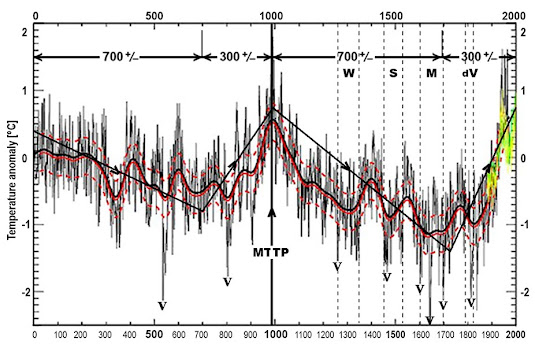
The point of most interest in Fig 3 is the present temperature peak and the MWP peak at 1000 AD which correlate approximately with the solar millenial cycle seen in Fig2. The various minima of the Little Ice age and the Dalton minimumof the early 19th century also show up well.
The general principal is to perfom spectral and wavelet analysis on the the temperature and any possibly useful driver associated time series to find any quasicyclic patterns which can be cross correlated. (possibly with appropriate time lags)
For a general review of this approach see several Scafetta papers eg
http://www.fel.duke.edu/~scafetta/pdf/scafetta-JSTP2.pdf
For decadal scale variations a 60 year cycle ,which seems to correlate temperatures and the PDO, is well established see the post" Global Cooling -Methods and Testable Decadal Predictions" at
http://climatesense-norpag.blogspot.com.
Furthermore it is clear that the cosmic ray intensity time series is the best proxy for "solar activity "and
that this correlates meaningfully with temperature with perhaps a 10- 12 year lag.
see Fig 3 CD from Steinhilber http://www.pnas.org/content/early/2012/03/30/1118965109.full.pdf
Fig4
It is not a great stretch of the imagination to propose that the 20th century warming peaked in about 2003 and that that peak was a peak in both the 60 year and 1000 year cycles.On that basis the conclusions of the post referred to above were as follows.
1 Significant temperature drop at about 2016-17
2 Possible unusual cold snap 2021-22
3 Built in cooling trend until at least 2024
4 Temperature Hadsst3 moving average anomaly 2035 - 0.15
5Temperature Hadsst3 moving average anomaly 2100 - 0.5
6 General Conclusion - by 2100 all the 20th century temperature rise will have been reversed,
7 By 2650 earth could possibly be back to the depths of the little ice age.
8 The effect of increasing CO2 emissions will be minor but beneficial - they may slightly ameliorate the forecast
cooling and help maintain crop yields .
9 Warning !! There are some signs in the Livingston and Penn Solar data that a sudden drop to the Maunder
Minimum Little Ice Age temperatures could be imminent - with a much more rapid and economically disruptive
cooling than that forecast above which may turn out to be a best case scenario
For a dicussion of the effects of cooling on future weather patterns see the 30 year Climate Forecast 2 Year update at
http://climatesense-norpag.blogspot.com/2012/07/30-year-climate-forecast-2-year-update.html
How confident should one be in these above predictions? The pattern method doesn't lend itself easily to statistical measures. However statistical calculations only provide an apparent rigour for the uninitiated and in relation to the climate models are entirely misleading because they make no allowance for the structural uncertainties in the model set up.This is where scientific judgement comes in - some people are better at pattern recognition than others.A past record of successful forecasting is a useful but not infallible measure. In this case I am reasonably sure - say 65/35 for about 20 years ahead. Beyond that, inevitably ,certainty drops.
This is where the Seven Alarmists scientific judgement was lacking - they embraced the CO2 meme with irrational exuberance and gave poor old Blair ,Cameron Clegg and Miliband the feeling that CO2 disaster was certainly coming and so embarked on their quixotic pursuit of windmills,solar panels biomass, fossil power plant closings,GHG targets and the whole quite mad dogs breakfast that constitutes British climate and energy policy.
I do hope that some of the Seven might even yet review their positions along the lines outlined above and at least say publicly that any coming warming is much less certain than they once thought and that the government might usefully abandon their wasteful subsidies of renewables and forget GHG emission limits and thus reduce the price of energy to British industy and ordinary people.
There are seven prominent establishment scientists who have played an important role in promoting the flawed scientific basis for Britains truly irrational and economically disastrous climate and energy policies.Their views on Catastrophic Anthropogenic Global Warming have been trumpeted by the Ecoleft press,the BBC and Britains chattering classes and largely unthinkingly, adopted by Blair ,Cameron ,Clegg, Miliband and a large majority of MPs as the basis for policy without any serious independent self consideration of their likely validity.
The seven are Sir John Houghton,Sir Bob Watson, Sir David King, Sir John Beddington,Sir Robert May,Lord Rees and Sir Paul Nurse. Their titles indicate that they have been good reliable chaps and played the British Political Establishment's Honours game with some skill.It is increasingly clear, as the earth obstinately refuses to warm up,that they have got it all wrong .They and the Politicians need to start again from square one and rethink the whole thing.Here are some helpful suggestions.
2 GETTING STARTED - DON'T DISCOUNT THE OBVIOUS UNTIL YOU HAVE TO.
If you want to know what future temperatures might be you might reasonably start not by building a detailed climate model but by looking at the current range of temperatures and what factors seem to cause them to change. You might observe the following amazing facts
a) Night is colder than day.
b) Winter is colder than summer.
c) It is cooler in the shade than in the sun
d) Temperatures vary more wildly in deserts and hot humid days are more uncomfortable than dry hot days - humidity might be an important factor.
e)Since you likely have a few A levels- and even a degree or two in something or other you might well have heard of the Ice Ages and their relationships to the Earths orbit around the sun and the tilt and wobbles of the Earth's Axis ie the Milankovitch cycles.Surely you must conclude that these are the major climate drivers on the scale of thousands of years.
f)You might also consider whether the current climate is unusually hot or cold.Some slight knowledge of history might bring to mind frost fairs on the Thames and the Little Ice Age. Even perhaps the Maunder Minimum without sunspots during the 17th century . The 300 years of Viking settlements in Greenland during the Medieval Warm Period and viniculture in Britain suggests a warmer world in earlier times than at present while the colder Dark Ages separate the MWP from the Roman Climate optimum.
g)Having heard of Greenhouse Gasses you might note however that CO2 is about 400ppm of the Atmosphere and think ,reasonably ,that it is very unlikely that such a little tail should wag such a big dog.
Conclusion - a person of reasonable common sense and intelligence might well conclude that given these simple observations the main temperature drivers were the number of hours of sunshine,the amount of cloud cover,the humidity and the height of the sun in the sky at midday and that the present day was not outside the range of climate variability for the last 2000 years and that no government action or policy was required or would be useful with regard to GHGs.These common sense conclusions embrace much more of the truth than the Seven Alarmists ever managed to grasp or to admit, while Britains leading politicical leaders are apparently incapable of using what little common sense they might possibly possess in this particular.area.
3. AVOID THE IPCC - AL GORE CO2 TRAP
The IPCC, led for several years by John Houghton and Bob Watson, is a political organisation.Its mission was not to investigate the causes of climate change but to estimate the effects of anthropogenic climate change.It simply assumed climate change was anthropogenic and in fact defined "climate change "as being anthropogenic for its purposes. By 2011 this definition was no longer tenable because the Earth was not warming as forecast..The IPCC 2011 SREX report says
"Uncertainty in the sign of projected changes in climate extremes over the coming two to three decades is relatively large because climate change signals are expected to be relatively small compared to natural climate variability”
.Note - uncertainty in the “sign” means they think the earth may even cool over this interval - but they still shy away from using the dreaded c word .
The IPCC's neat solution to this "minor" problem was simply to change the definition of what they meant by climate change and to concentrate, in the upcoming AR5 report ,on scaring the public and politicians with extremes because the actual temperature trend had turned against their projections and could no longer credibly be used for this purpose.
The SREX Report says:
“several of the definitions used in this Special Report differ in breadth or focus from those used in the AR4 and other IPCC reports.]
Climate Change: A change in the state of the climate that can be identified (e.g., by using statistical tests) by changes in the mean and/or the variability of its properties and that persists for an extended period, typically decades or longer. Climate change may be due to natural internal processes or external forcings, or to persistent anthropogenic changes in the composition of the atmosphere or in land use.2[INSERT FOOTNOTE 2: This definition differs from that in the United Nations Framework Convention on Climate Change (UNFCCC), where climate change is defined as: “a change of climate which is attributed directly or indirectly to human activity that alters the composition of the global atmosphere and which is in addition to natural climate variability observed over comparable time periods"
In order to make the anthropogenic climate change a factor important enough to justify their own existence and to drive government CO2 policies the IPCC and its modellers and the Seven Alarmists had to perform the following mental gymnastics to produce or support a climate sensitivity to a doubling of CO2 of about 3 degrees.
a) Make the cause follow the effect . ie, even though CO2 changes follow temperature changes ,they simply assume illogically that CO2 change is the main driver.
b) The main GHG - Water vapour - also follows temperature independently of CO2 yet the effect of water vapour was added on to the CO2 effect as a CO2 feedback for purposes of calculating CO2 sensitivity.
c) Ignore the very serious questions concerning the relaibility of the ice core CO2 data which was used to produce the CO2 hockey stick (Fig 1) and to relate CO2 to temperature. (Fig2) From Fig 2 for example one might well conclude that if CO2 was driving temperature it is an Ice House not a Greenhouse gas on Millenial scales.
Fig1 (Beck 2006)
Fig2
Conclusion - The temperature projections of any models based on these irrational and questionable assumptions have no place in serious dicussion.All the innumerable doom-laden papers on impacts in the IPCC reports and elsewhere (eg Stern report) which use these projections as a basis are a complete and serious waste of time and money.Until you know within well defined limits what the natural variability actually is it is not possible to estimate the sensitivity of global temperatures to anthropogenic CO2 with any useful accuracy as far as policy is concerned.
Unfortunately for the Jeremaids of the Seven Pillars of Unwisdom they have gambled their scientifc reputations and positions on these illogical propositions and are so far out on the limbs of the tree of knowledge that they will find it hard to climb back before their respective boughs break.
4. HOW TO PROCEED RATIONALLY - LOOK FOR PATTERNS AND PERIODICITIES IN THE TEMPERATURE RECORD
The IPCC,academic and governmental climate science industry obviously needed to do more than simply inform the governments of the common sense conclusions of section 2 in order to keep the grant money flowing and professional opportunities expanding.Certainly the scope ,mechanics, and drivers of climate change are topics of very considerable legitimate scientific interest in their own right but funding would be limited unless catastrophe was forecast.
The IPCC "team" realised correctly that in order to predict the future they needed a good record of past temperatures certainly over at least last 2000 years or so and as much further back as proxy data would allow.Also in order to scare the public and drive policy it was necessary to show that current warm temperatures were out of the range of previous measurements. First they had to do away with Lamb's (and the real world's) Medieval Warming Period which appeared in the first IPCC report. In 1998 and 99 Mann produced the infamous" Hockey Stick" so beloved and exploited by Al Gore. The Seven Alarmists implicitly or explicitly still appear conceptually locked in to the original Mannian graph although he himself has moved on considerably..A large amount of extremely valuable work has been done in gathering proxy temperature data in the last 15 years. Here are links to some of the most relevant papers.
http://stephenschneider.stanford.edu/Publications/PDF_Papers/MannBradleyHughes1998.pdf
http://www.ncdc.noaa.gov/paleo/pubs/mann_99.html
note Espers comments on the above at
http://eas8001.eas.gatech.edu/papers/Esper_et_al_Science02.pdf
and see how Mann's hockey stick has changed in later publications
http://www.pnas.org/content/105/36/13252.full
http://www.meteo.psu.edu/holocene/public_html/shared/articles/MannetalScience09.pdf
an important paper by Berggren et al relating solar activity to climate is
http://www.eawag.ch/forschung/surf/publikationen/2009/2009_berggren.pdf
and another showing clearly the correlation of the various climate minima over the last 1000 years to cosmic ray intensities -( note especially Fig 3C ,D below ) is: Steinhilber et al - 9400 years of cosmic radiation and solar activity from ice cores and tree rings:
http://www.pnas.org/content/early/2012/03/30/1118965109.full.pdf
for Holocene climate variability in general there is much food for thought in Mayewski et al :
http://yly-mac.gps.caltech.edu/AGU/AGU_2008/Zz_Others/Li_agu08/Mayewski2004.pdf
Of particular interest with regard to the cause of the late 20th century temperature increase is Wang et al:
http://www.atmos-chem-phys.net/12/9581/2012/acp-12-9581-2012.pdf
for an immense compendium of articles and data including a summary of projections for the future see:
www.appinsys.com/GlobalWarming
Having some passing acquantance with the above literature I would suggest that the currently most useful compilation for thinking about the record of the last 2000 years is.
Christiansen and Ljungqvist 2012
http://www.clim-past.net/8/765/2012/cp-8-765-2012.pdf
Fig.3
The point of most interest in Fig 3 is the present temperature peak and the MWP peak at 1000 AD which correlate approximately with the solar millenial cycle seen in Fig2. The various minima of the Little Ice age and the Dalton minimumof the early 19th century also show up well.
The general principal is to perfom spectral and wavelet analysis on the the temperature and any possibly useful driver associated time series to find any quasicyclic patterns which can be cross correlated. (possibly with appropriate time lags)
For a general review of this approach see several Scafetta papers eg
http://www.fel.duke.edu/~scafetta/pdf/scafetta-JSTP2.pdf
For decadal scale variations a 60 year cycle ,which seems to correlate temperatures and the PDO, is well established see the post" Global Cooling -Methods and Testable Decadal Predictions" at
http://climatesense-norpag.blogspot.com.
Furthermore it is clear that the cosmic ray intensity time series is the best proxy for "solar activity "and
that this correlates meaningfully with temperature with perhaps a 10- 12 year lag.
see Fig 3 CD from Steinhilber http://www.pnas.org/content/early/2012/03/30/1118965109.full.pdf
Fig4
It is not a great stretch of the imagination to propose that the 20th century warming peaked in about 2003 and that that peak was a peak in both the 60 year and 1000 year cycles.On that basis the conclusions of the post referred to above were as follows.
1 Significant temperature drop at about 2016-17
2 Possible unusual cold snap 2021-22
3 Built in cooling trend until at least 2024
4 Temperature Hadsst3 moving average anomaly 2035 - 0.15
5Temperature Hadsst3 moving average anomaly 2100 - 0.5
6 General Conclusion - by 2100 all the 20th century temperature rise will have been reversed,
7 By 2650 earth could possibly be back to the depths of the little ice age.
8 The effect of increasing CO2 emissions will be minor but beneficial - they may slightly ameliorate the forecast
cooling and help maintain crop yields .
9 Warning !! There are some signs in the Livingston and Penn Solar data that a sudden drop to the Maunder
Minimum Little Ice Age temperatures could be imminent - with a much more rapid and economically disruptive
cooling than that forecast above which may turn out to be a best case scenario
For a dicussion of the effects of cooling on future weather patterns see the 30 year Climate Forecast 2 Year update at
http://climatesense-norpag.blogspot.com/2012/07/30-year-climate-forecast-2-year-update.html
How confident should one be in these above predictions? The pattern method doesn't lend itself easily to statistical measures. However statistical calculations only provide an apparent rigour for the uninitiated and in relation to the climate models are entirely misleading because they make no allowance for the structural uncertainties in the model set up.This is where scientific judgement comes in - some people are better at pattern recognition than others.A past record of successful forecasting is a useful but not infallible measure. In this case I am reasonably sure - say 65/35 for about 20 years ahead. Beyond that, inevitably ,certainty drops.
I do hope that some of the Seven might even yet review their positions along the lines outlined above and at least say publicly that any coming warming is much less certain than they once thought and that the government might usefully abandon their wasteful subsidies of renewables and forget GHG emission limits and thus reduce the price of energy to British industy and ordinary people.
Wednesday, April 17, 2013
Open Request for Simple Predictions from James Hansen and Kevin Trenberth
Over the last several years it has become increasingly clear that the earth is not warming according to the IPCC model predictions (projections ) . Both Hansen and Trenberth recognise the problem.Hansen suggests that Chinese pollution is counter balancing the expected surface warming and that this surface warming pause might continue for several decades to come.By contrast Trenberth suggests that the missing heat has gone mainly into the oceans and that the warming pause could last for 15 - 50 years. In addition Trenberth in a presentation at :
http://www.cpc.ncep.noaa.gov/products/outreach/proceedings/cdw31_proceedings/S6_05_Kevin_Trenberth_NCAR.ppt
proposes a strong natural negative feedback which has not been included in the IPCC- Met Office models and which independently of all the other evidence would necessarily substantially reduce model warming predictions.
By contrast there are a growing number of predictions of Global Cooling based on declining solar activity. See eg most recently Steinhilber and Beer http://onlinelibrary.wiley.com/doi/10.1002/jgra.50210/abstract
In an earlier post " Global Cooling Methods and Testable Decadal Predictions " on my Blog at
http://climatesense-norpag.blogspot.com also at
http://wattsupwiththat.com/2013/04/02/global-cooling-methods-and-testable-decadal-predictions/
several predictions for future cooling were made - summarised as follows.
1. Significant temperature drop at about 2016-17
2. Possible unusual cold snap 2021-22
3. Built in cooling trend until at least 2024
4. Temperature Hadsst3 moving average anomaly 2035 - 0.15
5. Temperature Hadsst3 moving average anomaly 2100 - 0.5
6. General Conclusion – by 2100 all the 20th century temperature rise will have been reversed,
7. By 2650 earth could possibly be back to the depths of the little ice age.
8. The effect of increasing CO2 emissions will be minor but beneficial - they may slightly ameliorate the forecast cooling and help maintain crop yields .
9.Warning !! There are some signs in the Livingston and Penn Solar data that a sudden drop to the Maunder Minimum Little Ice Age temperatures could be imminent – with a much more rapid and economically disruptive cooling than that forecast above which may turn out to be a best case scenario.
Most western governments have developed economically costly climate and energy policies based on the premise that CO2 sensitivity is about 3 degrees, and that CAGW can be avoided by engineering anthropogenic CO2 emissions to keep the temperature increase no more than 2 degrees.These policies make no sense if CO2 is not the main climate driver and if, in fact, the earth is entering an extended cooling spell because of declining solar activity.
As two of the main advocates of the CAGW paradigm and in view of their recent statements on the possible extended time span of the warming pause it would clarify the situation for policy makers and everyone else if they could see their way clear to putting forward in its most simple form their current predictions along the lines of points 1-9 above or most importantly, and at least, items 4 and 5 - their most likely values for the Hadsst3 moving average (5 year) in 2035 and 2100.
The other points might merit a one or two word comment eg "absolutely not" or "possibly"
Drs Hansen and Trenberth your response to this request would be most welcome . Thanks in advance Norman Page.
http://www.cpc.ncep.noaa.gov/products/outreach/proceedings/cdw31_proceedings/S6_05_Kevin_Trenberth_NCAR.ppt
proposes a strong natural negative feedback which has not been included in the IPCC- Met Office models and which independently of all the other evidence would necessarily substantially reduce model warming predictions.
By contrast there are a growing number of predictions of Global Cooling based on declining solar activity. See eg most recently Steinhilber and Beer http://onlinelibrary.wiley.com/doi/10.1002/jgra.50210/abstract
In an earlier post " Global Cooling Methods and Testable Decadal Predictions " on my Blog at
http://climatesense-norpag.blogspot.com also at
http://wattsupwiththat.com/2013/04/02/global-cooling-methods-and-testable-decadal-predictions/
several predictions for future cooling were made - summarised as follows.
1. Significant temperature drop at about 2016-17
2. Possible unusual cold snap 2021-22
3. Built in cooling trend until at least 2024
4. Temperature Hadsst3 moving average anomaly 2035 - 0.15
5. Temperature Hadsst3 moving average anomaly 2100 - 0.5
6. General Conclusion – by 2100 all the 20th century temperature rise will have been reversed,
7. By 2650 earth could possibly be back to the depths of the little ice age.
8. The effect of increasing CO2 emissions will be minor but beneficial - they may slightly ameliorate the forecast cooling and help maintain crop yields .
9.Warning !! There are some signs in the Livingston and Penn Solar data that a sudden drop to the Maunder Minimum Little Ice Age temperatures could be imminent – with a much more rapid and economically disruptive cooling than that forecast above which may turn out to be a best case scenario.
Most western governments have developed economically costly climate and energy policies based on the premise that CO2 sensitivity is about 3 degrees, and that CAGW can be avoided by engineering anthropogenic CO2 emissions to keep the temperature increase no more than 2 degrees.These policies make no sense if CO2 is not the main climate driver and if, in fact, the earth is entering an extended cooling spell because of declining solar activity.
As two of the main advocates of the CAGW paradigm and in view of their recent statements on the possible extended time span of the warming pause it would clarify the situation for policy makers and everyone else if they could see their way clear to putting forward in its most simple form their current predictions along the lines of points 1-9 above or most importantly, and at least, items 4 and 5 - their most likely values for the Hadsst3 moving average (5 year) in 2035 and 2100.
The other points might merit a one or two word comment eg "absolutely not" or "possibly"
Drs Hansen and Trenberth your response to this request would be most welcome . Thanks in advance Norman Page.
Tuesday, April 2, 2013
Global Cooling - Methods and Testable Decadal Predictions
1. Methods and Premises
My approach to climate science is based on Baconian empirical principles as presented in a series of earlier posts on this site (http://climatesense-norpag.blogspot.com) notably:
6/18/10 Thirty Year Climate Forecast
7/19/12 30 Year Climate Forecast -2 year Update
10/30/12. Hurricane Sandy-Extreme Events and Global Cooling
11/18/12 Global Cooling Climate and Weather Forecasting
1/22/13 Global Cooling Timing and Amount
2/18/13 Its the Sun Stupid - the Minor Significance of CO2
From the data and papers linked to on these earlier posts I have drawn on a few basic premises on which the new forecasts rely.
1 .The IPCC climate models on which the entire CO2 phobia depends ignore basic common sense and show poor scientific judgement and so were, and are, so badly structured as to be inherently useless for temperature prediction. Climate sensitivity to doubling CO2 is probably 1 degree or less. The GH analogy conceptually misleads both the climate scientists and the general public. A much better analogy for the atmosphere is an holey insulating blanket with holes of varying size at differnt times according to the size and number of Tropcal Cyclone convection cells. These holes provide a substantial variable negative feedback to warming which is not included in the climate models. see Trenberth
http://www.cpc.ncep.noaa.gov/products/outreach/proceedings/cdw31_proceedings/S6_05_Kevin_Trenberth_NCAR.ppt
2.The best way of distinguishing the main climate trends and drivers is by power spectrum and wavelet analysis of any time series which might be pertinent and correlation of these power spectra to distinguish forcings and feed backs.
3.A small number of time series are useful proxies for and can usefully and economically represent the trends in and the drivers of a large proportion of the past global climate variabilty and point the way to the likely future.It is not necessary to know the precise mechanisms and time series interactions which produce these time series observations in order to use them for successful prediction.
4.The present analysis which looks ahead to 2035 and 2100 is based on a few simple ideas and empirical observations..
a) There has been no net warming since 1997 with CO2 up 8+% .Global Temperatures have been declining since 2003-4 The period from 2003- 2005 represents a peak in both the 60 year PDO cycle and in a millennial solar cycle.
b) Because of the thermal inertia of the oceans and the more extreme regional high frequency variability of the land data the Global SST data are the most useful representation of the overall global climate trend.
c)Not withstanding b) above and indeed because of the greater variability of the NH temperatures the currently most useful representation of temperature trends over the last millennial solar cycle for practical and conceptual purposes ie hockey stick or non hockey stick is
Christiansen and Ljungqvist 2012 fig5 at:
http://www.clim-past.net/8/765/2012/cp-8-765-2012.pdf see Fig1 below. - describe it how you will
d) It is not unreasonable to suggest that temperature trends from 2000 - 3000 AD could well repeat the pattern of trends from 1000- 2000. AD
e)The temperature trends in the first +/- 100 years after the peak are likely to be the reverse of the trends in the +/- 100 years before the peak and the Hadsst3 data set Figs 2 and 3 is a generally accepted representation of the latter trend.
f)The main climate driver is the sun . Incoming solar radiation is modulated by the Milankovitch orbital cycles and by variations in solar "activity" manifested by changes in GCR flux at the earth,by changes in EUV radiation, changes in the frequency and energy of CMEs and Proton events ,changes in solar wind speed and changes in TSI.Incredibly ,only the small TSI change is considered in the IPCC models-.The change in albedo caused by the GCR- cloud iris effect and the change in atmospheric chemistry caused by UV variations are probably more important than TSI itself.
g)A lunar influence is also evident in the temperature power spectrum.
h )The Neutron count can act as a useful proxy for solar "activity" particularly as the instrumental data can be projected back via the 10Be flux for millions of years..
2.Analysis and Forecast.
This post provides a revised version of the post on 1/22/13 "Global Cooling Timing and Amount (NH)" In this earlier post future temperature changes were estimated with reference to Christiansen and Ljungqvist 2012 fig5
FIG 1
Here I make the same assumption that the current temperature peak is an approximate repeat of the +/- 1000 AD solar cycle related temperature peak (Fig1 ) .The simplest assumption for trends following the peak is that the downslope to about 2650 AD may well look like the downslope from 1000 to1650.Naturally predictions beyond the 30 years which coincides with a PDO declining temperature trend would be increasingly more speculative.
Using the HADSST 3 data as a go-by (figs 2 and 3) produces the following estimates .
Fig 2
Hadsst 3(blue) and 2 (red) Feb 2013 from http://www.climate4you.com/Text/Climate4you_February_2013.pdf
The rising trend peaks out at 2003-5 Fig2..A rise occurred from 1975 - 2003-5. We might therefore look for a similar cooling from 2005 to 2035 The average peak temperature has an Hadsst 3 anomaly of about +0.38 . The rise from 1975 was from about -0.15 to +0.38 = +0.53 . and thus we might look for a similar decline in global SSTs temperatures to - 0.15 by 2035. This would coincide well with the current 30 year cooling phase of the PDO. More speculatively we might similarly estimate a recovery to + 0.1 by about 2060 followed by further Global cooling to - 0.5 by 2100 - equivalent to the 1910 temperature.
See the Hadley chart Fig3 below from http://www.cru.uea.ac.uk/cru/data/temperature/HadSST3.pdf
Fig 3
Of course these numbers relate to the general trend- during the downtrend we would expect higher frequency variabilty in temperature highs and lows to the same extent as seen in Fig 2. but both would generally decline until 2035.
These forecasts and trends are generally consistent with the broad trends in the Oulu neutron count since 1964 Fig4 which I suggest may well be considerd as a key Solar Activity Proxy -- SAP. It seems that there is a +/- 12 year lag between the SAP and the temperature. see Fig3 in Usoskin et al
http://www.clim-past.net/8/765/2012/cp-8-765-2012.pdf
The decline in the count minima from solar cycles 20-22 ie from 1969 - 1991 corresponds roughly to the temperature rise from the early 1980s to the 2003-5 temperature peak . It also matches well with the increase in the count of hours of sunshine during the same period dicussed by Wang et al
http://www.atmos-chem-phys.net/12/9581/2012/acp-12-9581-2012.pdf
which may well represent an open phase of the iris effect.
The relatively higher counts at the cycle 23 and especially the cycle 24 neutron minima troughs (solar cycle SSN peaks) suggest a continuing downtrend in temperatures to at least 2024.
There was a secular change in the related Ap index in 2004-5 which could presage a sharp temperature drop in about 2016-17 and the Oulu data show an increase in the neutron count also in 2004- 5 which might indicate the same thing and which is alredy built in to the system.
Fig 4
It is possible that the record 20th century peak in the 2009 count might indicate a real cold snap in 2021-22.
3. Summary
1 Significant temperature drop at about 2016-17
2 Possible unusual cold snap 2021-22
3 Built in cooling trend until at least 2024
4 Temperature Hadsst3 moving average anomaly 2035 - 0.15
5 Temperature Hadsst3 moving average anomaly 2100 - 0.5
6 General Conclusion - by 2100 all the 20th century temperature rise will have been reversed,
7 By 2650 earth could possibly be back to the depths of the little ice age.
8 The effect of increasing CO2 emissions will be minor but beneficial - they may slightly ameliorate the forecast
cooling and help maintain crop yields .
9 Warning !! There are some signs in the Livingston and Penn Solar data that a sudden drop to the Maunder
Minimum Little Ice Age temperatures could be imminent - with a much more rapid and economically disruptive
cooling than that forecast above which may turn out to be a best case scenario.
My approach to climate science is based on Baconian empirical principles as presented in a series of earlier posts on this site (http://climatesense-norpag.blogspot.com) notably:
6/18/10 Thirty Year Climate Forecast
7/19/12 30 Year Climate Forecast -2 year Update
10/30/12. Hurricane Sandy-Extreme Events and Global Cooling
11/18/12 Global Cooling Climate and Weather Forecasting
1/22/13 Global Cooling Timing and Amount
2/18/13 Its the Sun Stupid - the Minor Significance of CO2
From the data and papers linked to on these earlier posts I have drawn on a few basic premises on which the new forecasts rely.
1 .The IPCC climate models on which the entire CO2 phobia depends ignore basic common sense and show poor scientific judgement and so were, and are, so badly structured as to be inherently useless for temperature prediction. Climate sensitivity to doubling CO2 is probably 1 degree or less. The GH analogy conceptually misleads both the climate scientists and the general public. A much better analogy for the atmosphere is an holey insulating blanket with holes of varying size at differnt times according to the size and number of Tropcal Cyclone convection cells. These holes provide a substantial variable negative feedback to warming which is not included in the climate models. see Trenberth
http://www.cpc.ncep.noaa.gov/products/outreach/proceedings/cdw31_proceedings/S6_05_Kevin_Trenberth_NCAR.ppt
2.The best way of distinguishing the main climate trends and drivers is by power spectrum and wavelet analysis of any time series which might be pertinent and correlation of these power spectra to distinguish forcings and feed backs.
3.A small number of time series are useful proxies for and can usefully and economically represent the trends in and the drivers of a large proportion of the past global climate variabilty and point the way to the likely future.It is not necessary to know the precise mechanisms and time series interactions which produce these time series observations in order to use them for successful prediction.
4.The present analysis which looks ahead to 2035 and 2100 is based on a few simple ideas and empirical observations..
a) There has been no net warming since 1997 with CO2 up 8+% .Global Temperatures have been declining since 2003-4 The period from 2003- 2005 represents a peak in both the 60 year PDO cycle and in a millennial solar cycle.
b) Because of the thermal inertia of the oceans and the more extreme regional high frequency variability of the land data the Global SST data are the most useful representation of the overall global climate trend.
c)Not withstanding b) above and indeed because of the greater variability of the NH temperatures the currently most useful representation of temperature trends over the last millennial solar cycle for practical and conceptual purposes ie hockey stick or non hockey stick is
Christiansen and Ljungqvist 2012 fig5 at:
http://www.clim-past.net/8/765/2012/cp-8-765-2012.pdf see Fig1 below. - describe it how you will
d) It is not unreasonable to suggest that temperature trends from 2000 - 3000 AD could well repeat the pattern of trends from 1000- 2000. AD
e)The temperature trends in the first +/- 100 years after the peak are likely to be the reverse of the trends in the +/- 100 years before the peak and the Hadsst3 data set Figs 2 and 3 is a generally accepted representation of the latter trend.
f)The main climate driver is the sun . Incoming solar radiation is modulated by the Milankovitch orbital cycles and by variations in solar "activity" manifested by changes in GCR flux at the earth,by changes in EUV radiation, changes in the frequency and energy of CMEs and Proton events ,changes in solar wind speed and changes in TSI.Incredibly ,only the small TSI change is considered in the IPCC models-.The change in albedo caused by the GCR- cloud iris effect and the change in atmospheric chemistry caused by UV variations are probably more important than TSI itself.
g)A lunar influence is also evident in the temperature power spectrum.
h )The Neutron count can act as a useful proxy for solar "activity" particularly as the instrumental data can be projected back via the 10Be flux for millions of years..
2.Analysis and Forecast.
This post provides a revised version of the post on 1/22/13 "Global Cooling Timing and Amount (NH)" In this earlier post future temperature changes were estimated with reference to Christiansen and Ljungqvist 2012 fig5
FIG 1
Here I make the same assumption that the current temperature peak is an approximate repeat of the +/- 1000 AD solar cycle related temperature peak (Fig1 ) .The simplest assumption for trends following the peak is that the downslope to about 2650 AD may well look like the downslope from 1000 to1650.Naturally predictions beyond the 30 years which coincides with a PDO declining temperature trend would be increasingly more speculative.
Using the HADSST 3 data as a go-by (figs 2 and 3) produces the following estimates .
Fig 2
Hadsst 3(blue) and 2 (red) Feb 2013 from http://www.climate4you.com/Text/Climate4you_February_2013.pdf
The rising trend peaks out at 2003-5 Fig2..A rise occurred from 1975 - 2003-5. We might therefore look for a similar cooling from 2005 to 2035 The average peak temperature has an Hadsst 3 anomaly of about +0.38 . The rise from 1975 was from about -0.15 to +0.38 = +0.53 . and thus we might look for a similar decline in global SSTs temperatures to - 0.15 by 2035. This would coincide well with the current 30 year cooling phase of the PDO. More speculatively we might similarly estimate a recovery to + 0.1 by about 2060 followed by further Global cooling to - 0.5 by 2100 - equivalent to the 1910 temperature.
See the Hadley chart Fig3 below from http://www.cru.uea.ac.uk/cru/data/temperature/HadSST3.pdf
Fig 3
Of course these numbers relate to the general trend- during the downtrend we would expect higher frequency variabilty in temperature highs and lows to the same extent as seen in Fig 2. but both would generally decline until 2035.
These forecasts and trends are generally consistent with the broad trends in the Oulu neutron count since 1964 Fig4 which I suggest may well be considerd as a key Solar Activity Proxy -- SAP. It seems that there is a +/- 12 year lag between the SAP and the temperature. see Fig3 in Usoskin et al
http://www.clim-past.net/8/765/2012/cp-8-765-2012.pdf
The decline in the count minima from solar cycles 20-22 ie from 1969 - 1991 corresponds roughly to the temperature rise from the early 1980s to the 2003-5 temperature peak . It also matches well with the increase in the count of hours of sunshine during the same period dicussed by Wang et al
http://www.atmos-chem-phys.net/12/9581/2012/acp-12-9581-2012.pdf
which may well represent an open phase of the iris effect.
The relatively higher counts at the cycle 23 and especially the cycle 24 neutron minima troughs (solar cycle SSN peaks) suggest a continuing downtrend in temperatures to at least 2024.
There was a secular change in the related Ap index in 2004-5 which could presage a sharp temperature drop in about 2016-17 and the Oulu data show an increase in the neutron count also in 2004- 5 which might indicate the same thing and which is alredy built in to the system.
Fig 4
It is possible that the record 20th century peak in the 2009 count might indicate a real cold snap in 2021-22.
3. Summary
1 Significant temperature drop at about 2016-17
2 Possible unusual cold snap 2021-22
3 Built in cooling trend until at least 2024
4 Temperature Hadsst3 moving average anomaly 2035 - 0.15
5 Temperature Hadsst3 moving average anomaly 2100 - 0.5
6 General Conclusion - by 2100 all the 20th century temperature rise will have been reversed,
7 By 2650 earth could possibly be back to the depths of the little ice age.
8 The effect of increasing CO2 emissions will be minor but beneficial - they may slightly ameliorate the forecast
cooling and help maintain crop yields .
9 Warning !! There are some signs in the Livingston and Penn Solar data that a sudden drop to the Maunder
Minimum Little Ice Age temperatures could be imminent - with a much more rapid and economically disruptive
cooling than that forecast above which may turn out to be a best case scenario.
Subscribe to:
Posts (Atom)